The Story of the Paper Scrap in Group Making
The story of the paper scrap in group making turns clean household offcuts into a shared collage, with simple ways to prepare materials and use them.
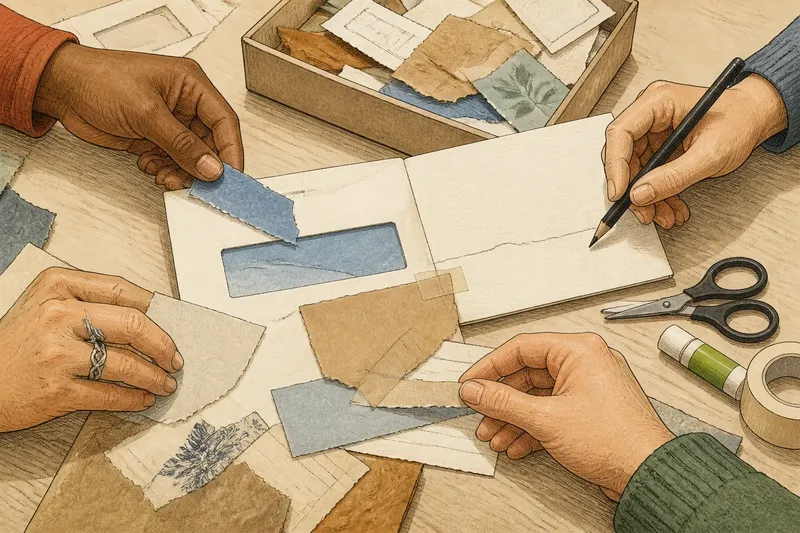
The story of the paper scrap in group making starts with a torn envelope, a paper-bag corner and the blank back of an old card. Put a few clean offcuts on a table and they can become a shared collage without anyone needing to bring art supplies or arrive with an idea.
What makes scrap paper useful for group making?
Scrap paper has already escaped the pressure of being pristine. Its torn edge can become a coastline; a window in an envelope can frame a colour beneath it. These accidental shapes give a group something specific to notice, without requiring anyone to invent a theme from scratch.
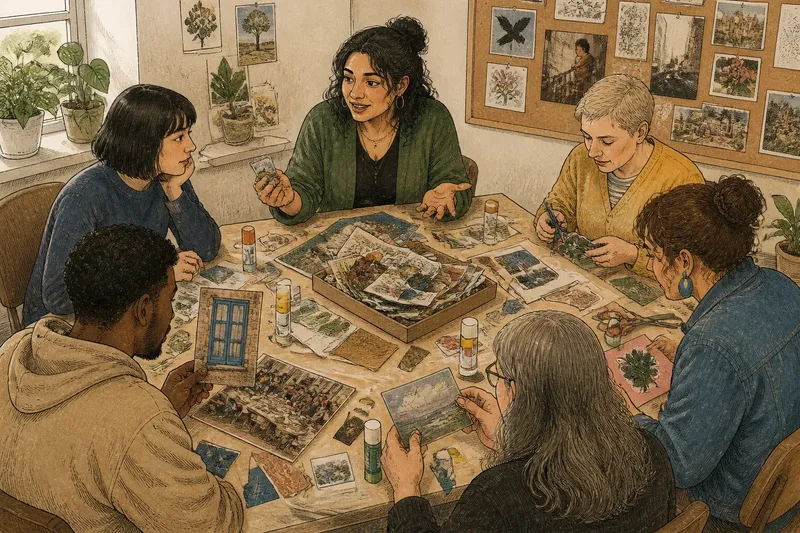
The material also suits small contributions. One person can choose a piece, another can move it, and someone else can add a pencil mark. Rather than assigning roles or asking everyone to make a finished image, let the table itself become a place for trying combinations.
Which scraps and tools should you set out?
Choose clean, dry paper that is comfortable to handle: plain envelopes, paper bags, greeting cards, unused photocopy offcuts and blank notice margins are all possibilities. Remove addresses, names and other private details. Leave out paper with food residue, loose staples or a coating that is difficult to mark.
A shallow box or tray keeps the collection easy to browse. Set out a pencil, scissors, glue stick and masking tape, but leave some paper untouched. A piece may work better as a surface, a movable layer or a frame than as something to cut up.
- Check for private details: If a scrap shows an address or name, remove that section or leave the whole piece out; otherwise, add it to the shared collection.
- Check cleanliness and condition: If paper is damp, stained or unpleasant to handle, discard it; if it is clean and dry, keep it available.
- Check the mix of shapes: If the box contains only narrow strips, add a few larger clean pieces; if broad and irregular shapes are already present, stop collecting for now.
- Check cutting and folding: If a piece is awkward to cut or fold, offer it intact as a base or remove it; if it handles comfortably, place it with the other usable scraps.
- Check whether tools are necessary: If the group wants to arrange pieces without attaching them, use a tray and skip glue; if pieces need to stay in place, set out tape or a glue stick.
- Check what remains after the session: If a piece is still clean and reusable, return it to the box; if it is marked or glued, follow local recycling guidance or dispose of it as appropriate.
It is not worth hunting for a perfect range of colours or textures. A small, varied handful is easier to use than a curated collection that feels too special to touch.
How can you turn leftovers into a shared arrangement?
Start with an invitation tied to the paper: choose one piece and place it beside another. Anyone can add a pencil line, fold or strip of tape, or simply suggest where a piece might go. Keep the arrangement movable until people are ready to attach anything.
Say the table holds a windowed envelope, a torn blue strip and a card with a blank back. One person places the blue paper behind the window; another turns the card sideways and draws a pencil line from its edge. The resulting arrangement might read as a patch of sky framed by a doorway. If it does not, the group can shift the pieces again; the useful result is a visible combination to respond to, not a finished picture.
Offer a tray or spare sheet as a base for testing placements. Someone who would rather not handle glue can point out a position or draw on a separate scrap. If attention wanders, leave the pieces where they are and pause; not every quiet moment needs an activity added to it.
What questions come up during a scrap-paper session?
Does every scrap need a story?
No. A piece can be chosen for its shape or colour, or simply because it is nearby. It can remain ordinary paper even after the group has used it.
What if someone wants to keep a piece?
Let them set it aside or take it home. The shared arrangement can use other scraps, and nobody needs to contribute an item they want to keep.
How much sorting is useful?
Remove private or unsuitable material and make the rest easy to see. Sorting into exact colours or sizes is unnecessary unless the group has a particular reason to do it.
Can glued paper go in the recycling bin?
It depends on local collection rules and the materials used. Check local recycling guidance for paper with glue, tape or marks rather than assuming it belongs in the paper bin.
How does the paper scrap become part of the group?
It happens when someone can pick up an available piece and make a choice with it. The story of the paper scrap in group making is less about turning leftovers into an impressive object than about letting an ordinary offcut shape what appears on the table.
Afterwards, ask whether the group wants to keep the arrangement, take pieces home or return usable scraps to the box. That small decision leaves the next session with a clearer starting point: a work in progress, a tidy collection or an empty tray ready for something else.