The Finished-Thing Trap in Group Activities
A process-based aim for group activities shifts attention from polished results to shared choices, helping organisers shape a gathering people can join on their own terms.
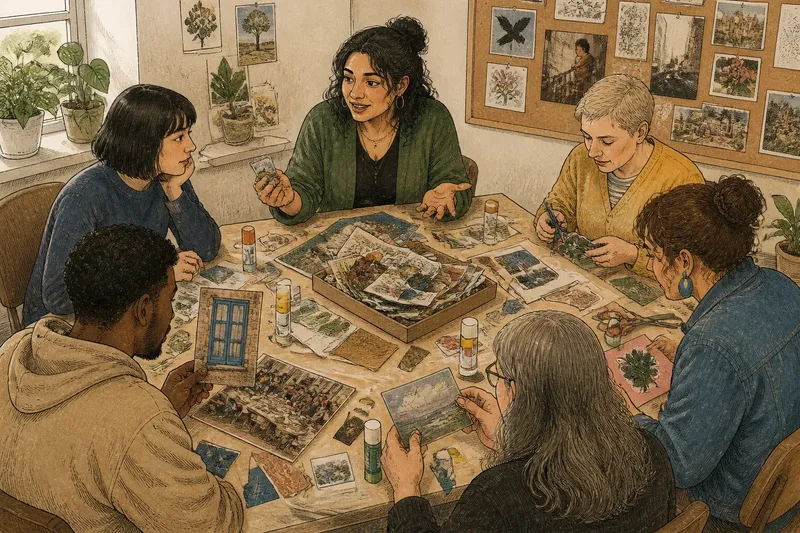
A process-based aim changes what a group activity asks people to notice. At a community collage table, for instance, the focus can be how images change meaning when placed together, rather than whether everyone finishes a postcard. That distinction gives organisers a way to shape the session without turning its outcome into a measure of participation.
Imagine Mina, who is hosting an informal collage evening in a neighbourhood room. She has set out old magazines, scrap paper, glue sticks and blunt scissors, and plans to pin postcards on a noticeboard. When someone asks what a postcard is supposed to look like, Mina hears a useful question about the activity’s design: is the group exploring images, or trying to meet an unstated standard?
What is a process-based aim for group activities?
A process-based aim names an action or kind of attention that participants can share. “Notice how moving an image changes the scene” is more specific than “be creative”, but it leaves room for different interpretations and outcomes.
This is not an argument against making objects. Someone might enjoy completing a postcard, while another person prefers to rearrange scraps or talk about an image. The aim is to give the gathering a focus that does not depend on one particular finished form.
That focus also helps an organiser decide what belongs in the room. If the group is exploring how placement shifts meaning, loose pieces and movable images fit better than an elaborate set of instructions for making matching cards.
How can Mina change the activity without making it vague?
Mina notices that several people are asking what counts as a postcard rather than choosing images. She pauses and says, “Let’s see what changes when two unrelated pictures sit beside each other.” The display remains an option, but the activity no longer requires everyone to make something for it.
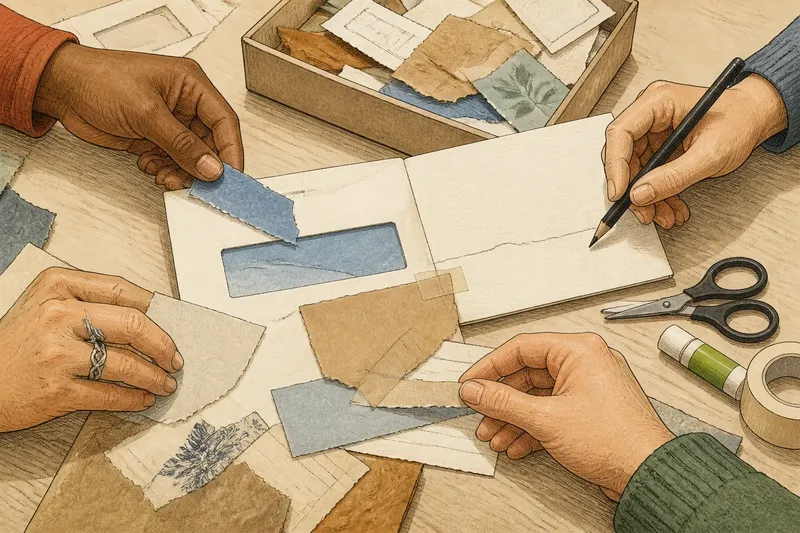
She moves the scraps into the middle of the table and suggests a few ways to begin: overlap two pictures, leave a gap, or move one image and notice what the new arrangement suggests. Participants can follow one of those invitations, adapt it or choose another way to explore the material.
Those suggestions give the group something concrete to do. They are not a hidden scoring system: an arrangement does not need to be clever, attractive or easy to explain. The useful question is whether the activity’s focus is clear enough for people to make their own choices.
What can a process aim change at the table?
Say Joel arrives expecting to be bad at collage. He picks up a scrap showing a blue window and places it beside a picture of a crowded table. After Mina offers the idea of trying an unlikely pairing, he moves the window above the table instead. He shows the arrangement to a neighbour, who says the window looks like a screen.
Joel shifts the scrap again, leaving a gap between the two images. He has not made a postcard, but he and his neighbour have explored how placement changes what they see. At the same table, another participant completes a card and enjoys having a finished object to take home. The process aim can accommodate both choices.
For an organiser, the difference shows up in the decisions the session makes possible. A participant can change direction without having to catch up, and a person who wants to finish an object can do so without setting the standard for everyone else.
Which design choices support the shared focus?
Before the session, Mina can use a short set of checks to decide whether her setup supports the aim. Each result points to a practical adjustment:
- Check the invitation. If it promises a particular finished object, then add the process aim alongside it; otherwise, keep the wording simple and describe what people will explore.
- Check whether a newcomer can start mid-session. If the activity depends on earlier instructions, then add a visible, self-contained prompt; otherwise, leave the materials ready to use.
- Check whether materials can be rearranged. If changing an arrangement would damage it, then add loose scraps or removable pieces; otherwise, keep the existing materials available.
- Check whether the first action is clear. If participants are asking what to do, then offer one concrete invitation, such as placing two pictures side by side; otherwise, let them choose their own starting point.
- Check whether the display is becoming the standard. If people seem focused on making work for the noticeboard, then restate that displaying work is optional; otherwise, leave the display as an open invitation.
- Check how the session will close. If a presentation of finished objects feels like the only ending, then offer a question about a choice or change instead; otherwise, let participants choose whether to share.
These checks are for shaping the activity, not judging individual contributions. It is not worth the effort to record every rearranged scrap or create a scorecard for participation. A few clear decisions about the room and invitation are more useful than a new standard everyone has to perform for.
How should the group share what happened?
At the end of Mina’s session, she asks what arrangement surprised people, or what changed after they moved something. Anyone can answer, point to a scrap or pass. A participant who has made a postcard can show it, but nobody has to present a finished result.
For a future gathering, Mina could keep the noticeboard for work people actively want to share. She could also describe the session in advance as an exploration of how image placement changes meaning. That tells newcomers what they will be invited to do without implying that their work must be display-ready.
Sharing can centre on decisions rather than products. A person might mention a surprising colour pairing, show where they left a gap or talk about why they changed direction. The group then has something specific to remember and discuss, even if most of the scraps return to the materials box.
What do people ask about process-based group activities?
Does a process-based aim mean nobody should finish an object?
No. A person can make a postcard, a collage or another object if that is what they want to do. The aim simply means that finishing one is not the only way to engage with the session.
How can an organiser tell whether the activity had a clear focus?
Notice whether the invitation gave people an understandable action or question to explore. If participants repeatedly ask what counts as a successful result, the wording or setup may need adjusting for the next session.
What should an organiser say when someone asks what to make?
Offer a concrete starting action tied to the session’s focus, such as placing two images together and noticing what changes. Then clarify that people can develop the arrangement, make an object or choose another way to explore.
Can the group share the activity without displaying finished work?
Yes. Invite people to share a choice, a change they noticed or an image they found interesting. Passing is also a clear option, so a closing conversation need not become a presentation.
What makes the next invitation clearer?
Before choosing materials, Mina can ask what she wants the group to notice or try together. For this collage evening, the answer is how image placement changes interpretation. That process-based aim for group activities can guide the invitation, the supplies and the closing question, while leaving participants free to decide whether they take an object home.