A Prompt Works Best When It Leaves a Door Open
Open-ended prompts for group creativity give a group a shared starting point and room to choose its own response, making a creative activity easier to join.
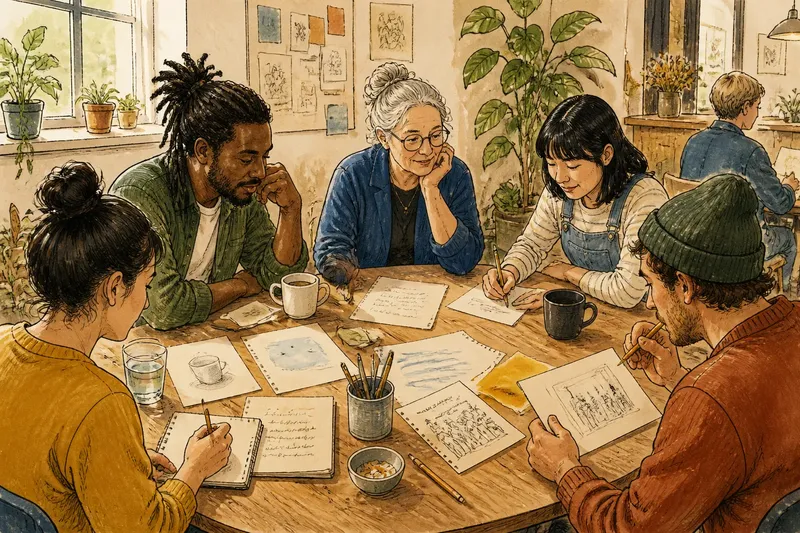
Open-ended prompts for group creativity work best when a group can recognise the shared subject without being steered towards one expected result. Ask people to respond to “a small change in the room”, and one might describe a shifting patch of light while another invents a new use for an empty cup. The invitation gives them a place to begin, not a model to copy.
That distinction matters in a kitchen, a community room or a staff break space. A useful prompt is not simply vague; it gives attention a direction while leaving the creative decision with each participant. The wording can be brief, but it should make clear what the group is gathering around.
What should the prompt point towards?
Start with a shared subject rather than a prescribed finished object. A sound, a colour, a daily ritual, a change in the weather or an imagined place can bring people together without deciding what they must make. “A familiar sound” might lead to a rhythm, a sketch of its source or a few descriptive words. “Draw a kettle” has a narrower destination.
Neither kind of prompt is automatically wrong. A specific object can suit an activity where everyone needs to practise the same technique. But if the aim is a shared creative exchange, a broad subject leaves more meaningful choices open.
Ask what you want participants to have in common. For noticing, direct attention to something observable. For imaginative play, choose a subject that can travel beyond literal description. The prompt should create a meeting point, not a hidden test of interpretation.
How much direction is enough?
Give the invitation one clear anchor and one roomy action. The anchor names what responses connect to; the action suggests how to begin. For instance: “Choose a sound you hear nearby and show what it suggests to you.” “Sound” keeps the activity together, while “show” leaves room for a sketch, a phrase, a gesture or an arrangement of objects.
Too little direction can feel like a blank page. “Be creative” asks people to invent both the subject and the response. Too much direction can turn an invitation into an assignment: “Draw a blue house with three windows and a red door” has already made most of the interesting choices. A good prompt removes the first hurdle without removing every decision.
Try verbs such as “notice”, “choose”, “remix”, “connect” and “imagine”. They suggest action without prescribing a single result. One specific noun and one open verb are often enough.
Which words keep the invitation welcoming?
Choose language that invites interpretation rather than setting a standard. “A place that feels welcoming” can mean different things to different people. “A beautiful room” may leave participants guessing whose taste counts. Words such as “best”, “proper” and “perfect” can make a playful activity sound like a judgement.
Check whether the prompt assumes a particular memory, identity or resource. Instead of asking everyone to recall a childhood holiday, invite them to choose a place they know or invent one. That wording gives people a subject without making personal disclosure the price of joining.
Use words that fit the activity’s actual medium. If the group has paper, pencils and a shared table, “arrange”, “sketch” or “describe” may be more helpful than a broad promise of every possible format. Keep the invitation usable in the setting where people will meet.
How can you check an open-ended prompt?
Try answering the prompt in several different ways before sharing it. This is a wording check, not a prediction of what anyone else will make. If your own responses all lead to the same object or phrase, change the subject or action.
Say you are preparing a prompt for a neighbourhood café, and the available materials are scrap paper and pencils. You write, “Respond to something that changes as the day goes on.” First, you sketch the light moving across a table; next, you write a short line about a cup growing cold; then, you invent a tiny scene about the queue. Those different routes stay connected to change, so you keep the anchor. If all three had depended on recognising the café’s sign, you would widen the subject to something changing in any familiar place.
Read the final wording aloud. Remove rules that do not help someone start, and check that the sentence sounds natural when spoken. A short invitation is easier to remember and adapt once conversation begins.
What should you say when you introduce it?
Offer the prompt plainly, then explain only the practical details people need. For example: “Choose something you notice on the way here and respond to it in a way that suits this table.” Point out where the paper and pencils are, and say how contributions will be shared if sharing is part of the activity. Leave a pause for people to decide what they want to do.
Make the social shape of the activity clear. If participants may pass, say so without making a performance of it. If contributions will be displayed, explain where and for how long in ordinary terms. Those details help people understand the invitation without dictating what their work should mean.
Set boundaries that belong to the setting. A short gathering may call for a quick response rather than a polished piece; a shared table may have only the materials already there. Let those limits keep the activity manageable, not define the answer.
What questions help refine an open-ended prompt?
Can an open-ended prompt still have a clear theme?
Yes. A shared subject such as a familiar sound can connect the activity while each person chooses what to make of it. A clear theme does not need a single correct response.
Should everyone use the same materials?
Use shared materials when they suit the setting or help the group work together. Paper and pencils can support several kinds of response, while spoken ideas may fit better where there is no table. Choose materials for the activity you can actually host.
What if nobody knows how to begin?
Repeat the prompt’s anchor and offer two different kinds of starting point, such as a phrase or a quick sketch. Keep both brief so they clarify the invitation rather than becoming examples people feel obliged to imitate.
How can you make the prompt easier to adapt?
Keep the subject recognisable and make the action replaceable. A group can respond to “a sound nearby” by describing it, drawing its shape or connecting it to an imagined scene. If one verb excludes the materials or setting, swap it for a more workable one.
How do you know whether the wording is working?
Listen for questions about the expected answer or watch for people waiting for a model before they begin. Those signs may mean the prompt sounds more prescriptive than intended. If participants start in different ways, the invitation is offering both direction and choice.
Varied-looking results are not the only sign of an open prompt. A group may settle on similar responses because the subject catches everyone’s attention. What matters is whether the wording leaves room to choose an approach, not whether every contribution looks unrelated.
Afterwards, ask what part of the prompt helped people start and what they would change. Their answers can point to a useful edit: replace a narrowing word, make the subject clearer or remove a rule that did no work.
What is not worth the effort?
Do not try to anticipate every possible uncertainty in the prompt itself. A long explanation can make a small activity sound like a form to complete. Nor is maximum novelty the goal; a familiar subject can still lead somewhere unexpected when the wording leaves choices open.
For open-ended prompts for group creativity, a visible boundary and an undecided destination make a sturdy pairing. Name what the group is gathering around, choose an action that fits the materials and setting, and leave the interpretation to the people taking part. One useful final check is to remove any word that tells them what a successful response must look like.