A Story Swap for a Rainy Afternoon
A story swap for a rainy afternoon turns a few prompts and ordinary paper into a relaxed gathering, with clear choices for sharing, listening and closing.
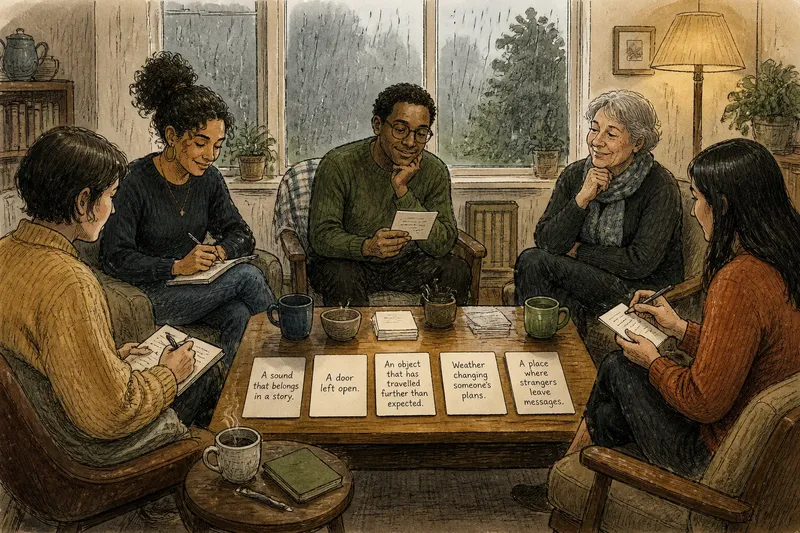
A story swap for a rainy afternoon needs only a few prompts and a clear agreement about how contributions will be treated. Keep each offering small: a remembered sound, an invented opening or a detail from an ordinary day. People can listen, write or speak, and the gathering can still feel shared without becoming a round of performances.
Choose a comfortable room, put out plain paper and pens, and explain the shape of the activity before anyone begins. The aim is to trade small pieces of story, not to draw out private histories or polish anyone’s writing.
What should you prepare for a story swap?
Arrange chairs so people can see one another without feeling they are on display. Keep a clear route to the door and leave room for someone to sit a little apart. A kitchen table or a loose circle of chairs can work; there is no need to stage the room like a reading.
Write a few prompts on slips of paper or cards. Choose invitations that allow both fiction and observation:
- A sound that belongs in a story.
- A door left open.
- An object that has travelled further than expected.
- Weather changing someone’s plans.
- A place where strangers leave messages.
Plain paper and ordinary pens are enough for jotting down a phrase. A phone timer can help you notice when the gathering is running long, but a visible countdown is not worth the effort if it makes people feel hurried.
In the invitation, say that guests can share a fragment, invent one, listen or leave the activity at any point. Avoid describing the event as a chance to “share something personal”; that can sound like a condition of entry.
How can you make the exchange feel relaxed?
Start by explaining how the turns will work. People can volunteer, agree to a loose round, or let the host offer the next turn. Make clear that nobody needs to explain a choice not to contribute. Then demonstrate the scale of a fragment with a brief invented scene: a glove on a bus seat, perhaps, with no grand reveal required.
Keep contributions short enough to leave space for several voices. A few sentences, an opening line or a description of one image can be plenty. If someone is finishing a thought, let them land it naturally rather than cutting them off.
Decide whether the group will respond. Listening without critique is often the simplest arrangement. If people want to respond, invite a short comment about an image or phrase that stayed with them, rather than advice about how to improve the piece. Do not turn a personal detail into a question-and-answer session.
How should you set boundaries around shared stories?
At the start, ask everyone not to repeat another person’s story outside the room with identifying details unless that person agrees. Be candid: a host can ask for care, but cannot ensure that every participant will keep something confidential. For that reason, invite people to share only what they are comfortable having heard by the group.
If a contribution becomes personal, acknowledge it without pressing for more. The speaker can continue, change direction or stop. The host does not need to interpret the story or open it for group discussion. If someone raises a concern that calls for more support than the gathering can offer, speak privately and encourage them to contact someone they trust or a suitable professional.
How can you adapt the activity to the group?
For close friends, prompts can play with shared interests while leaving room for invented answers. For neighbours or newer acquaintances, objects, sounds and imaginary places keep the activity from depending on personal disclosure.
With a mixed-age group, use concrete subjects that do not require specialist knowledge. An object or a made-up destination gives children and adults different ways into a fragment. Explain unfamiliar words, and avoid treating one style of response as more sophisticated than another.
If a group prefers not to speak in front of everyone, people can write on separate slips and volunteers can read theirs aloud. A host can read a contribution without naming its writer if the writer asks. Do not collect or read anonymous slips unless the group has agreed how they will be handled.
Online, offer a prompt in chat or a shared document and give people room to type. Do not require cameras or spoken turns. Read contributions aloud only with the group’s agreement, especially if a post could identify its writer.
What should you do when a prompt or moment feels awkward?
Change course without making a person account for the choice. If a prompt seems to lead towards private territory, offer an imaginary alternative or move to a neutral subject such as an object in the room. A quiet pause can simply be thinking time; it does not need to be filled immediately.
Say you are hosting friends on a wet afternoon, with five prompt cards on the table, including one about a childhood memory. A guest hesitates when that card reaches them. You offer the card about an open door instead, and they write an invented sentence about a neighbour’s greenhouse; the visible result is that the exchange continues on a fictional track without requiring them to explain their hesitation.
What if nobody volunteers?
Wait a moment, then offer a fresh neutral prompt or read a short invented fragment of your own. If the room remains quiet, let people talk informally or end the activity rather than treating silence as a problem to solve.
Can people write instead of speaking?
Yes. Put out paper and pens, then let people keep their words private, read them aloud themselves or ask the host to read them with permission. A written fragment should not become a compulsory substitute for speaking.
Should the host respond to every story?
Agree on the approach beforehand. A nod or a simple thank-you may be enough; if the group wants comments, keep them brief and focused on a detail the listener noticed.
Can participants share stories beyond the gathering?
Ask people not to repeat identifiable details without the storyteller’s agreement, while being clear that the host cannot control what others do afterwards. Guests should choose material they are comfortable sharing with the people present.
How can you close the story swap?
Close with a brief invitation to offer a word, image or sentence to take away, while making it fine to stay quiet. Or simply thank everyone for listening and sharing at their own pace. There is no need to rank the stories or collect the paper.
For a story swap for a rainy afternoon, a satisfying result may be one memorable image and an easy return to tea or conversation. Keep the prompts flexible, agree on respectful handling of what is shared, and let the gathering end before anyone feels obliged to perform.